Table of Contents
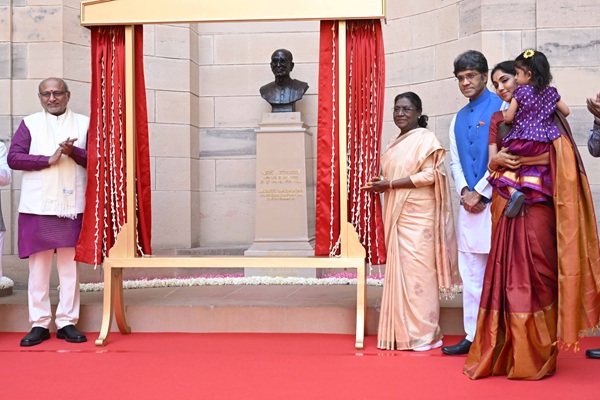
Rajaji Bust Rashtrapati Bhavan — these four words now mark one of the most significant acts of mental decolonisation in post-independence India. On February 23, 2026, President of India Smt. Droupadi Murmu unveiled the bust of Chakravarti Rajagopalachari — popularly known as Rajaji — at Rashtrapati Bhavan, New Delhi. This historic event also inaugurated the Rajaji Utsav, a week-long celebration honouring the life, values, and extraordinary legacy of India’s first and only Indian Governor General.
The installation of the Rajaji Bust at Rashtrapati Bhavan is part of a broader national mission to shed colonial vestiges and embrace, with pride, the richness of India’s culture, heritage, and timeless democratic traditions. Just as India is making bold strides in defence and global partnerships — as seen in the India-France H125 Helicopter Assembly Line initiative — this cultural and symbolic transformation reflects a confident, self-reliant nation on the move.
A Symbolic Shift: Rajaji Bust Rashtrapati Bhavan Replaces Edwin Lutyens
The Rajaji Bust at Rashtrapati Bhavan now stands at the Grand Open Staircase near Ashok Mandap, right opposite the statue of Mahatma Gandhi. Significantly, this space previously held the bust of Edwin Lutyens — the British architect who designed colonial New Delhi. The replacement of Lutyens’ bust with the Rajaji Bust Rashtrapati Bhavan installation is widely seen as a profound and deliberate act of mental decolonisation. This event is a milestone in India’s journey of reclaiming its historical narrative.
Prime Minister Narendra Modi, in a special message read at the event, stated that Rashtrapati Bhavan today stands not as a seat of power, but as a visible embodiment of democratic self-confidence rooted in Indian civilisation. He specifically noted that placing the Rajaji Bust Rashtrapati Bhavan exactly where Edwin Lutyens’ bust stood makes this an important act of mental decolonisation.
President Murmu’s Inspiring Address at Rajaji Utsav
President Droupadi Murmu, addressing the gathering at the Rajaji Bust Rashtrapati Bhavan unveiling, recalled that when Rajaji arrived at the Government House (now Rashtrapati Bhavan), he placed portraits of Ramakrishna Paramahamsa and Mahatma Gandhi in his room — sending a powerful message that Swaraj had already been established in the hearts of Indians, even while the country was formally still a Dominion.
The President highlighted the transformation of Rashtrapati Bhavan from a colonial residence to a truly national institution:
- The gallery once adorned with portraits of British imperial officials has been replaced by the Param Vir Dirgha, now displaying portraits of Param Vir Chakra awardees — India’s bravest soldiers.
- The Granth Kutir has been established at Rashtrapati Bhavan to preserve manuscripts and texts of India’s classical languages.
- Rashtrapati Bhavan and its estates in Shimla, Hyderabad, and Dehradun have been opened to all citizens to connect with India’s democratic traditions and cultural heritage.
President Murmu also recalled how Rajaji, as Governor General, initiated grain cultivation inside the Rashtrapati Bhavan complex to inspire farmers during food shortages — even ploughing the field himself. She drew a direct link between Rajaji’s spirit of self-reliance and today’s vision of Swadeshi and Aatma-Nirbharata.
“As we move ahead towards making Viksit Bharat by 2047, icons like Rajaji inspire us with their ideas and ideals.” — President Droupadi Murmu
Rajaji Utsav 2026: Exhibition Open for Public (Feb 24 – March 1)
Following the Rajaji Bust Rashtrapati Bhavan unveiling, President Murmu graced the Rajaji Utsav at Rashtrapati Bhavan Cultural Centre, visiting a photo and book exhibition on Rajaji’s life and watching a documentary film on his remarkable journey.
Key dignitaries present at the Rajaji Bust Rashtrapati Bhavan event included Vice President Shri C. P. Radhakrishnan, Minister of Education Shri Dharmendra Pradhan, Minister of Culture Shri Gajendra Singh Shekhawat, Deputy Chairman of Rajya Sabha Shri Harivansh, Minister of State for Law Shri Arjun Ram Meghwal, and Minister of State for I&B Dr L. Murugan.
A public exhibition on Rajaji’s life and work will remain open from February 24 to March 1, 2026, at Amrit Udyan, Rashtrapati Bhavan. All citizens are encouraged to visit and draw inspiration from this great leader’s legacy.
Vice President’s Message: India’s Ongoing Decolonisation Journey
Vice President C. P. Radhakrishnan described Rajaji Utsav as yet another milestone in India’s journey of breaking away from colonial legacy — an ongoing transformation across governance, law, education, culture, and national identity. He cited several powerful examples:
- Raj Bhavans becoming Lok Bhavans
- PMO being referred to as Seva Tirtha
- Central Secretariat renamed Kartavya Bhavan
- Replacement of colonial-era criminal laws with new Indian criminal laws
- Installation of the statue of Netaji Subhas Chandra Bose near India Gate
- Construction of the National War Memorial
Who Was Chakravarti Rajagopalachari? The Man Behind the Rajaji Bust at Rashtrapati Bhavan
Chakravarti Rajagopalachari (December 10, 1878 – December 25, 1972) was one of the most versatile personalities in modern Indian history — a lawyer, freedom fighter, statesman, author, philosopher, and deeply spiritual leader. Understanding his legacy helps us appreciate why the Rajaji Bust Rashtrapati Bhavan unveiling carries such deep national significance.
Early Life and Education
Born in the village of Thorapalli, Salem district (present-day Krishnagiri district, Tamil Nadu), Rajagopalachari studied at Hosur Government School and Central College, Bangalore. He completed his law degree from Presidency College, Madras, and established a successful legal practice in Salem. His daughter Lakshmi later married Devdas Gandhi, the son of Mahatma Gandhi.
Freedom Struggle and Gandhi’s Conscience Keeper
Rajagopalachari joined the Indian National Congress in 1906. Gandhi himself called Rajaji his “conscience keeper.” He actively participated in the Non-Cooperation Movement, the Vaikom Satyagraha (against untouchability), and in 1930, led the Vedaranyam Salt Satyagraha in solidarity with Gandhi’s Dandi March. As Premier of the Madras Presidency (1937–1940), his government passed the historic Temple Entry Authorization and Indemnity Act (1939), opening Hindu temples to Dalits.
First and Only Indian Governor General
After independence, Rajagopalachari served as India’s first Governor of West Bengal (1947–48). In June 1948, he succeeded Lord Mountbatten as Governor General of India — becoming the first and only Indian citizen to ever hold this office — and served until January 26, 1950, when India became a Republic. The Rajaji Bust Rashtrapati Bhavan unveiling is a direct tribute to this singular achievement. He later served as Union Home Minister and Chief Minister of Madras State (1952–54).
Founder of Swatantra Party and “Licence-Permit Raj”
In 1959, Rajagopalachari founded the Swatantra Party — advocating free-market economics, individual liberty, and minimal government intervention. He famously coined the term “Licence-Permit Raj” to criticise Nehru’s bureaucratic controls. The Swatantra Party became the single largest opposition party in the Lok Sabha in the 1967 elections.
Literary Legacy: Bharat Ratna and Sahitya Akademi Awards
Rajaji wrote celebrated abridged English versions of the Mahabharata and Ramayana, translated the Thirukkural into English, and wrote extensively on Hinduism, politics, and governance. He received the Sahitya Akademi Award in 1958. In 1954, he was conferred the Bharat Ratna — India’s highest civilian honour — making him one of its very first recipients alongside Dr. Sarvepalli Radhakrishnan and Dr. C. V. Raman.
Rajaji’s Vision and the Road to Viksit Bharat 2047
The ideals championed by Rajagopalachari — Swaraj, Swadeshi, economic freedom, and moral self-governance — resonate deeply with India’s present goals. His belief that India’s economic policy must remain independent, liberal, and people-centred directly echoes the vision of Viksit Bharat (Developed India) by 2047.
President Murmu, Vice President Radhakrishnan, and Prime Minister Modi collectively underscored that the Rajaji Bust at Rashtrapati Bhavan is not merely a symbolic act — it is a continuous commitment to placing Indian consciousness, culture, and values at the centre of governance and national identity. Prime Minister Modi also highlighted this in his Mann Ki Baat address on February 22, 2026.
Conclusion: The Rajaji Bust Rashtrapati Bhavan — Honouring the Past, Inspiring the Future
The Rajaji Bust Rashtrapati Bhavan inauguration and the Rajaji Utsav represent a conscious national commitment to honour the architects of modern India on India’s own terms. Rajagopalachari’s life offers a timeless guide: that true freedom is not just a political achievement, but a moral, intellectual, and civilisational pursuit.
The public exhibition at Amrit Udyan, Rashtrapati Bhavan, from February 24 to March 1, 2026, is an excellent opportunity for every Indian — especially the younger generation — to connect with this extraordinary legacy and draw inspiration to build Viksit Bharat.
Source: Press Information Bureau (PIB), President’s Secretariat, Government of India. Press Release dated February 23, 2026.




Be First to Comment